
The Republic of Congo, known also as Congo-Brazzaville, is a State of Central Africa and a French ex-colony.
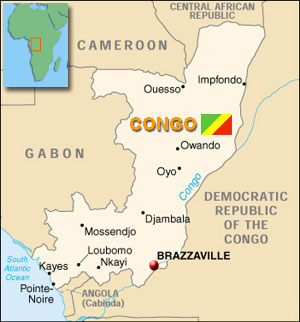
Carte Congo
The capital is Brazzaville (city of Brazza). Congo Brazzaville confines on north with Camerun and the Central African Republic , on east and south with the Democratic Republic of Congo (ex Zaire), on west with Gabon, on south – for a short distance – with the Angolan enclave of Cabinda and, on south-west, Congo leans out on the Atlantic Ocean.
Congo’s official language is French.
Congo Brazzaville lies in the very heart of Africa and it is constituted by equatorial forest, a rich savanna, great rich rivers full of fish.
The legendary Congo river is the second greatest river in the world, right after the Amazon river of Brasil. Congo river separates the two closest capital cities of the world: Brazzaville and Kinshasa (the latter one is the capital city of Congo’s confining Country the Rep. Dem. of Congo). These two cities are visible to one another with the naked eye. They’re separated from each other only by few kilometers of water ( the width of Congo river reaches 6 km in some points!) and they’re attainable to one another through a panoramic trip by boat or aquatic means.
The two Congos, the Democratic Republic one and the Popular Republic one, together with Angola, Gabon and northern Namibia, constituted the ancient Kingdom of Kongo. With the arrival of the first Europeans and their colonization, this Kingdom was conquered and separated among European countries: the Democratic Republic of Congo became a Belgian colony, while the Popular Republic of Congo became a French colony.
The capital city of Congo Brazzaville takes its name from the Italian native explorer Pier Savorgnan de Brazza, who worked for the French Navy. Pier believed that the exchanges between Europe and Central Africa should have been based on humanism and brotherhood. Pier had to fight against the conception for which colonization was solely slavery and looting. Brazza paid with his own life this different approach to African communities; it was the year 1905.
The forest of Congo is the second greater primary forest of the planet after the Amazonian one. Leaning out to the Atlantic ocean, Congo has got paradisiacal beaches made of white sand and framed by palms of various kinds. The abundance of sweet water fish (from rivers) and salty water ones (from the ocean) enriches the delicious local dishes. Fish is cooked – following the Congolese tradition – with vegetables and it’s accompanied by manioc.
Finally, the luxuriant and fertile land of Congo offers – beside what grows already in Occident – peanuts, bananas, platan bananas, papaya, mango, avocado, ananas… and palm wine!

Pointe Noire