1997

Seventh edition

MALAKI MA KONGO finally in Kinshasa

Malaki Educational - Congo

Malaki Educational - Congo

Planned to be held from 1997 july 3rd to 6th in Brazzaville, the 7th MALAKI MA KONGO edition could not be held because of some social political militar turbulences. But since Chance knows well its matters, Kinshasa – Brazzaville twin sister – agreed to welcome Malaki from 1997 december 20th to 1998 january 4th.
The seventh edition suddenly gave Malaki and the world’s two nearest capital cities’artists incredible chances to work together in that time of crisis.
This chance allowed also Patrice Lumumba’s and Franklin Bukaka’s dream – of transforming Congo river into a boulevard and not into an obstacle or fronteer – to be confirmed and actualized. Such dream had costed the two above mentioned great men their lives.
This seventh edition message was an accent put on the thousand year old predictions that left from ancient Egypt to the true Promised Land of Kongo Dia Ntotela.
Since the mists of time Kongo people wait for the star signal, as a Kongo prophecy says: Kongo Kingdom’s head looks like Kongo dia Mfoa (Brazzaville) and the day this Kongo dia Mfoa fiery’s head will wake up, the whole kingdom  will raise up.

Malaki asked a series of questions to be thought over to the participants, to know:

  • Didn’t the granades rain falling onto Brazzaville desturb this kingdom head’s rest?
  • And if this is the case, what will happen?
  • Didn’t Simon Kimbangu say to observe Mfoa Brazzaville’s coast because from there marveils will come?
  • And uo to Andrè Matsua to add: Ndombi ku ndombi sadidi mukanda, comanda diandi Masuandre, which can be translated in the sense that a project or an action cannot be fruitful to Black man when they are not his own invention’s emanation, but above all when they aren’t made under his control.

The Congo’s wisemen – from Congo, Angola and Congo Kinshasa – who gathered in Kinshasa for three weeks, knew that those moments were  weighty and the conference-debats themes well reflected such depth:

Mbuila battle and Kongo kingdom fdecline were brilliantly exposed by professor Ne Mabiala, who concluded his lecture in these terms: “Those who do not take into consideration either the origin either the consequences of the war that opposed Kongo to Portugal in 1665, will never comprehend what undermine the Kongo lands’ socio-political evolution.”

The second conference was entitled: from Simon Kimbangu to André Grenard Matsua, Ne Kongoes’ Cross path by Ne Kitoko Difukidi Kanda and Ne Masengo ma Mbongolo.

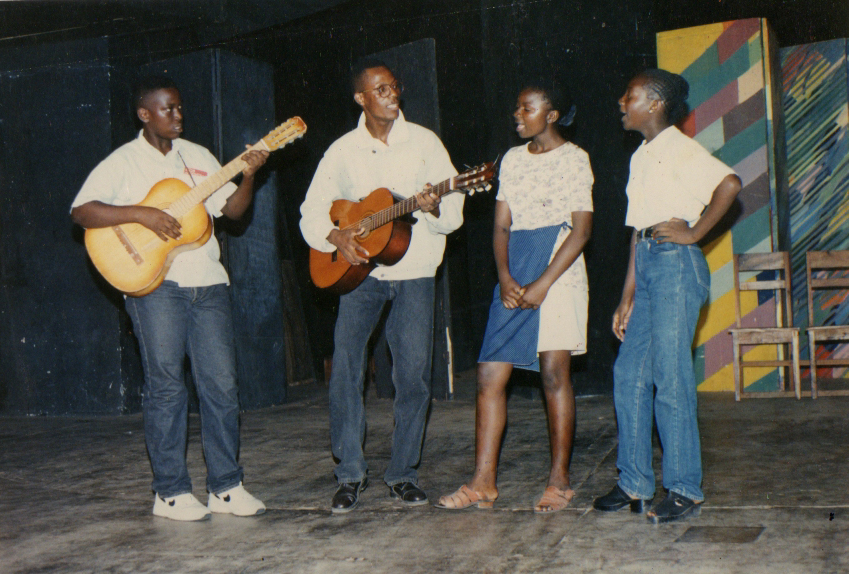
The artistiche performances were very beautiful, not to talk about the nice and valorous  Bundu Dia Kongo (kongo church) choir; Tuma Haut’s musical comedy; the kongo griot Ne Nkamu with his “Letter to the African Presidents”, and the Marabout théâtre with the Brazza-Kinshasa Via Paris theatre piece by Nzey Van Musala and Masengo Ma Mbongolo. Finally Africa’s mourning by Don Dieg  Nan Nkaka with Rocado Mayas théâtre  . But the discovery came from the Kongo Medicin Academy with Outhimpaku du Nganga (doctor)  Kumbu, proved that Kongo possesses a medicine that has nothing to envy to the Oriental or Occidental medicines. For example, deseases as appendicitis have no secrets for it, the same for cancer, liver cirrosis, tooth pain… Kongo medicine possesses also remedies for the Invisible, like for taking one away from the passion for cigarettes , stealing, adultery, terrorism, witchery, etc…

For discovering so much perspicacity, MALAKI asks the world only one thing:

A second of freedom, of independence
to save the world from all its evils.

1991-1992

1st and 2nd editions

of MALAKI MA KONGO Festival

press 1991

press 1991

The first two editions of  MALAKI MA KONGO festival can be summarized as a traditional entertainment with manioc tubers, potatoes, ignam tuber, corn, peanuts, the fodder “made in Kongo”, author of the big Camp Fire.
Malaki ma Kongo was very established, above all the african parable “bunzonzi”: exchange a verb, a smile, friendship so that hearts become permeables to their neighbor’s message. All this in a love and solidarity burst for finally a new Kongo to be born again, our beautiful country.
The party was big, all artists gathered. There was the life-theatre as lived by Kongo Dia Ntotela inhabitants. Malaki ma Kongo was the exhumed ancestral kermesse, on a dance step mode from now on national.
There was the pleasant theatre where people is invited backward to the stage, following a tradition dear to Kongo: spectators on stage, the comedians assist them, better: serve them.
One of the strongest images from the festival was that of the 1991 july 13th night, when Tshivili Tshibulu, Louya Mpene Malela and Masengo Ma Mbongolo, the festival three founders, met to light the Malaki ma Kongo camp fire up.
Already, sparks rose to the sky, to go across the ocean to reveal the upcoming  Rebirth of the Pharaons and of an Africa that would have gotten its independancy in the 2001 year.

1993

3rd edition:

MALAKI MA KONGO, an International Festival

Press 1993

Press 1993

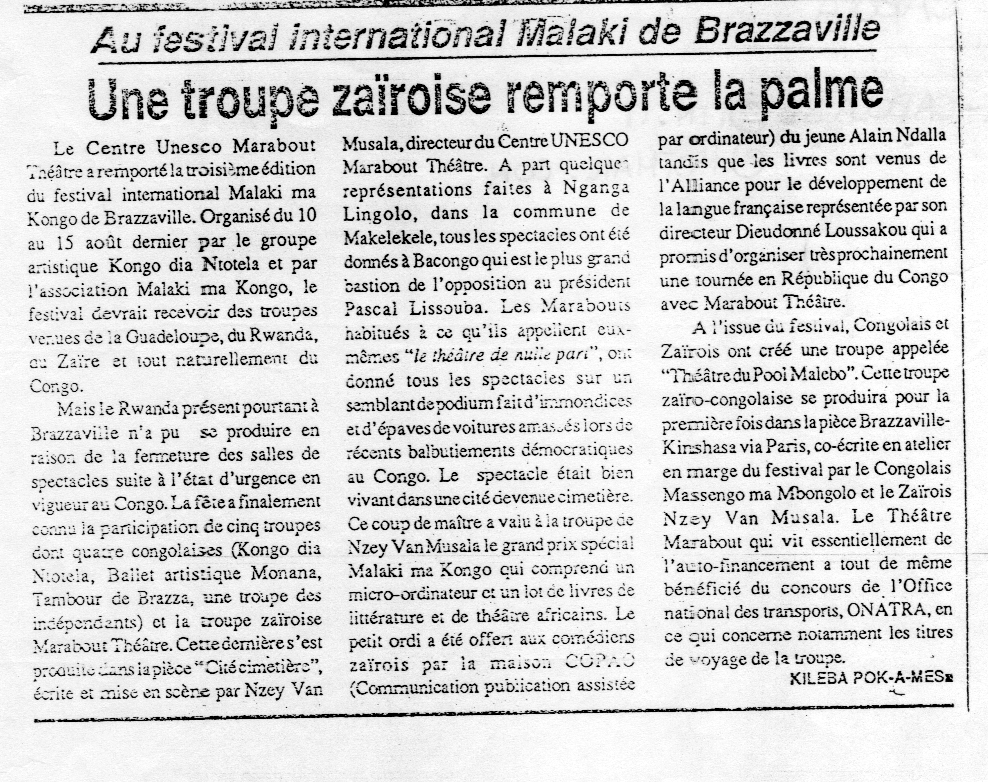
The Marabout Théâtre du Zaire Unesco center won the MALAKI MA KONGO festival Golden Palm.
Organized from august 10th to the 15th 1993 (under state of emergency funds) the festival should have received groups from Guadeloupe, Rwanda, Zaire and of course from Congo Brazzaville.
They reminded Malaki its duty in these terms:

Malaki  is entering in comunion with our ancester, no one can prevent us from doing so, especially those  who call themselves city administrators.

The festival knew the participation of five congolese groups (Kongo Dia Ntotela, Ballet Monana, Tambours de Brazza, an indipendent group from Mbama) and the Marabout Théâtre from Zaire. This last one, used to what they called “The nowhere theatre”, donated us all their shows on a stage-like podium made by garbage e car wrecks piled up in that time of recent ongo democracy stammerings.

The show was very alive in a city become a cemetary. This master stroke was worth the Grand Prix Special Malaki ma Kongo to Nzey group and it included a microcalculator and a pile of african literature and theatre books.

At the beginning of this festival, the Pool Malebo theatre group was created. This zairo-congolese troupe had as special mission that of concretizing Lumumba’s and Franklin Bukaka’s prophecies, which costed these last ones their lives. Such prophecy is about the unification of the two Congoes and the transformation of the Congo river into a boulevard and not a fronteer. The first Pool Malebo production was entitled: “Brazza Kinshasa Via Paris”, a Nzey and Masengo co-writing.

1998

8th edition

MALAKI MA KONGO

Special Return to Kongo Dia Ntotela, the Promised Land

Malaki ma Kongo 1998

Malaki ma Kongo 1998

It was planned that this edition would be held in a pilgrimage form.
Leaving from Kongo Dia Mfoa (Brazzaville), the festival should have moved to  Mbanza Kongo (ancient Kongo kingdom’s capital city) and Angola, passing through Kongo Dia Kinshasa.
But eventually the edition was held at the Mbongui Malaki Ma Kongo “Cultural centre for Africa and Pharaons reinassance”, sited by Continue reading

1994

« Special Return to the Origins»

with Nkelo Wa Kongo from Guadeloupe

press 1994

press 1994

The fourth edition was inaugurated in Ntsila Mamba, towards Nganga-lingolo, a Brazzaville’s suburb.
The choice of this site was not casual: here the caravan route that connects Nzadia  Mungwa  (the sea) with Nzadia Kongo (Kongo river) passes.
This edition knew the participation of guadeloupeans and zairoises. In the heart of this big ceremony three brave guys, Louya Mpene Malela, Massengo Ma Mbongolo e Tshivili Tshibulu had no other resource than that of their art e their granitic will, in a quite unconstrained dynamics: that of gather men of culture from all horizons around a memory, that of their Ancesters e land.
This was enough to make their gaiety cries heard up to over the Atlantic.

In short, this edition knew the participation of guadaloupeans artists as:  Jocelyn Gabali, Bébé Romspart, Mpemba  « Benzo », and  Marie France Massembo.

In the festival menu were theatre, plastic operas exhibitions, poetry, story telling, singing, theorical and scientific debates and above all… traditional dance. Different tam-tam sounds were heard: those from Kongo but also and especially the far off sounds of kongo drums and singing from Guadeloupe, enriched by the diaspora culture clash.

It was the perfect kermesse, as to abstract that hard civil war time that we were living, the tough time of Cfa franc devaluation.
And the audience, especially children, had flowed to come to this ancestral sanctuary and draw the necessary energy that would, tomorrow, make them become the Bukongo Kongo culture singers. A nowday plural culture because enriched by the emotions and humours from all our country’s regions and from the far off experience of all those who claim their Kongo roots.

One of the most important moments was the festival descent to the Massembo Loubaki train station, on the iron Congo-ocean road to satisfy and give honour to the guadeloupeans Marie France Massembo. She cared very much about seeing her ancesters’ village, and deeply lived this moment of happy reunion among tears. Then a rumbling of drum thunders accompanied “the prodigal daughter” arrived from the far off Guadeloupe to rejoin her “parents” remained in Africa. Gabali found again the Ngabali village and stream, as Benzo Mpemba found agin his Luango.

The fourth edition already revealed itselfas “the faithful translator of our ancestors thought who are close to the already moving diaspora”.

Since then, the bond between Africa and its prodigal children was renewed. Appointments were taken in Africa as in the Antilles, to get the Kongo puzzle rejoined. And a door for the Return to the Origins was opened, a real one, without any colonial or extraversion form’s heaviness.